

The Great Glen Way
A short, sweet and straightforward romp from one side of Scotland to the other
The Great Glen Way: The Basics
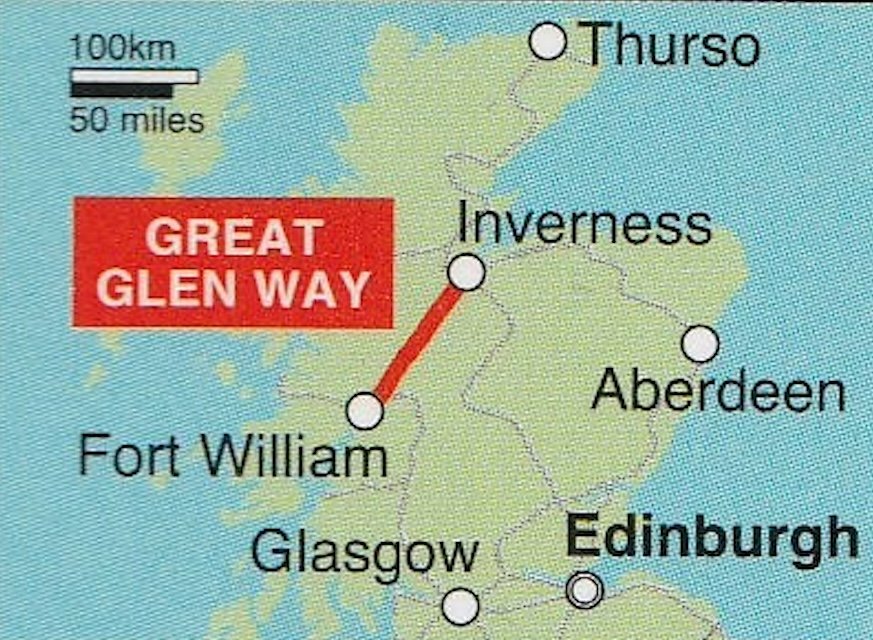
WHERE: The Great Glen cuts one enormous diagonal slash across the centre of Scotland, and this trails follows it faithfully from coast to coast.
HOW LONG IS THE GREAT GLEN WAY? The Great Glen Way is only 76-78 miles/122.3-125.5km, making it one of the shortest of the trails on this site.
WHERE DOES THE GREAT GLEN WAY BEGIN? The Great Glen Way starts where the West Highland Way, another of the original Long Distance Routes of Scotland ends, at Fort William.
AND WHERE DOES IT END? Inverness, the cultural capital of the Scottish Highlands, where the River Ness meets the Moray Firth.
HOW LONG DOES IT TAKE TO WALK THE GREAT GLEN WAY? 4-8 days
HOW HARD IS IT? Definitely one of the easiest of the trails to tackle. The walking for the first few days up to Fort Augustus is flat, easy and the path is well signposted. True, after Fort Augustus the trail does throw quite a few gradients in your path, but if the prospect of attempting those is too daunting there are several low-level alternative paths – all of which are still official – that can be taken instead.
IS IT A NATIONAL TRAIL: As it is in Scotland so it can’t be a National Trail (which is for Welsh and English trails only). But, like the West Highland Way, it was one of the original five of Scotland’s Long Distance Routes, and is now part of the rebranded and expanded collection of 29 long-distance footpaths north of the border known as Scotland’s Great Trails.
Introduction
I knew this day would eventually come. After 16 adventure-filled years, this was the first time I had to tackle a trail without my beloved dog, Daisy. Though she’s still alive, the truth is that she is no longer the energetic streak of black-and-white that would hare back and forth ahead of me on the trail. A stroke earlier this year had completely changed her. My love for the incontinent, slowly shuffling mound of drool and stench that now stands before me remains undimmed. She still loves her food, she still loves affection -and we in turn still adore her. But there’s no way I could take her on a long-distance walk anymore.
We never did manage to tackle all the National Trails together. The Pennine Bridleway was for a long while the only one of the (then) 16 National Trails in England and Wales that we hadn’t conquered. But we could never quite find the time to tackle it. Then they built a 17th National Trail, the monstrous new King Charles Coast Path, and it felt like they were moving the goalposts anyway.
So our record together is stuck at 15 National trails. But that’s OK, because it wasn’t our aim when we started to get the full set anyway. We just wanted to have adventures, and fun. And boy, we really have.
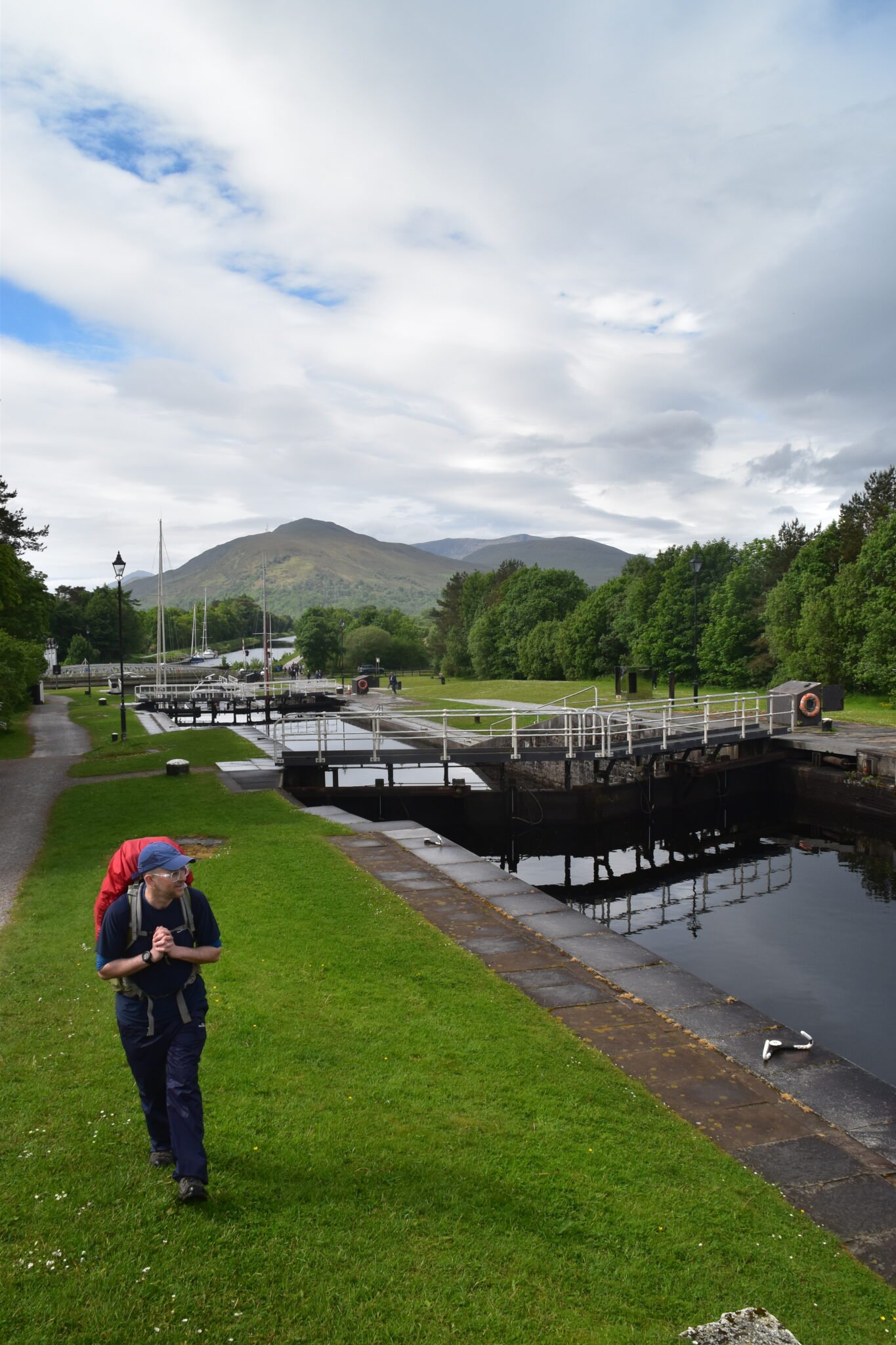
As a replacement for Daisy, on the Great Glen Way I took with me my good friend and fellow guide-book author, Joel, who, coincidentally, was with me and Daisy on our first outing together, the South-West Coast Path, back in 2011. Though nowhere near as cuddly or charsmatic as Daisy, his conversation and odour are both – just ever so slightly – better. And if he does have incontinence, well, at least he seems to manage it better than my dog ever does.
As a sign of just how much Daisy’s health has deteriorated, even Scotland’s Great Glen Way is now beyond her. I say ‘even’ because, as I found out when completing it one week in early summer, this is perhaps the easiest trail featured on this website. It’s one of the shortest and for the first half at least, one of the flattest too.
But for such a small, uncomplicated trails, in my opinion it also holds quite a few ‘best of’ awards too. On this website you’ll see that we think it’s the best trail for those looking to stay in hostels, the best for those looking to camp (including wild campers), and the trail that’s best served by public transport. Oh, and it’s also the best for monsters. But more about all that later.
Perhaps most importantly, we also think the Great Glen way is the best trail for those who’ve not tackled a long-distance footpath before…
Is the Great Glen Way for you?
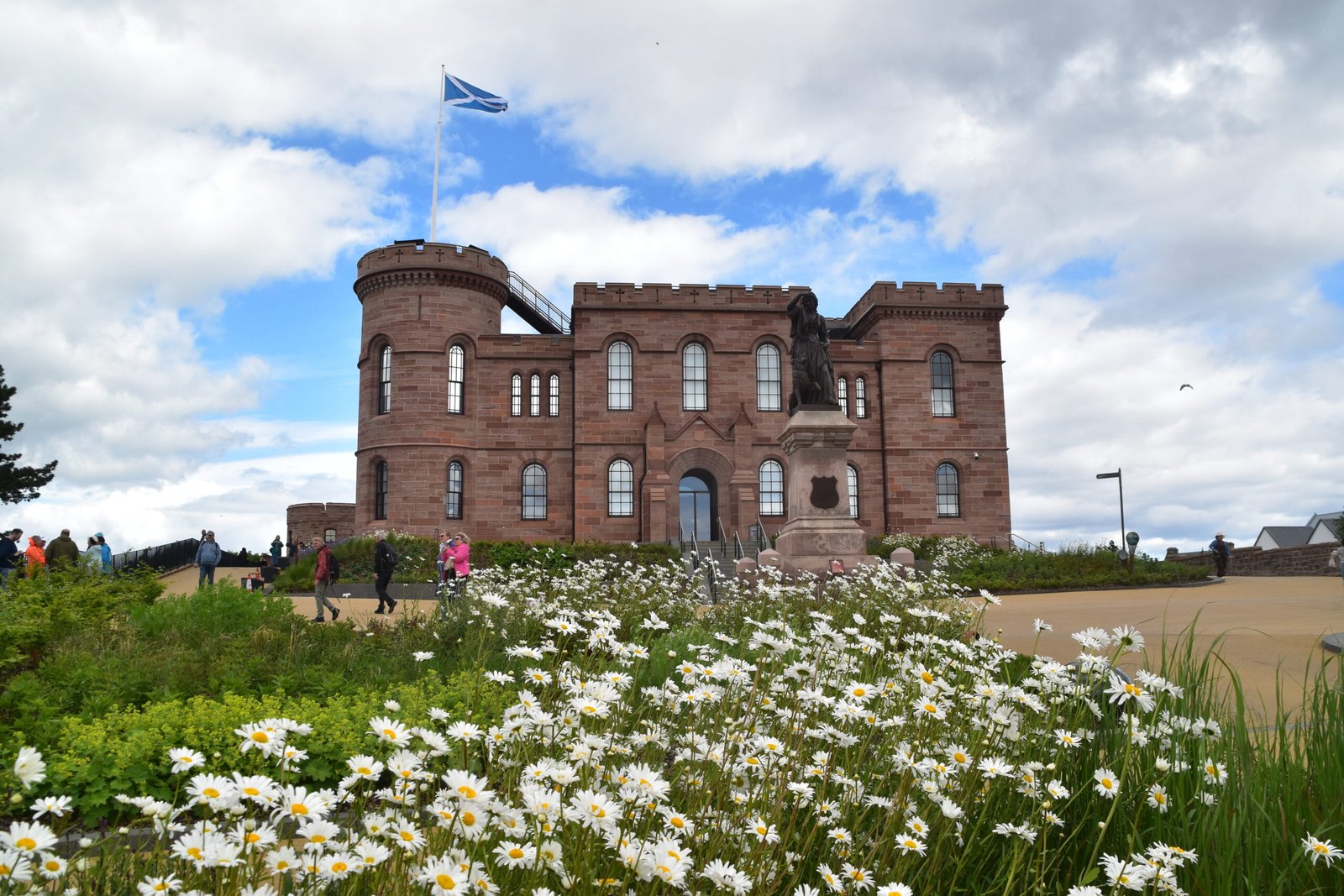
Inverness Castle – surely one of the best places to finish a National Trail.
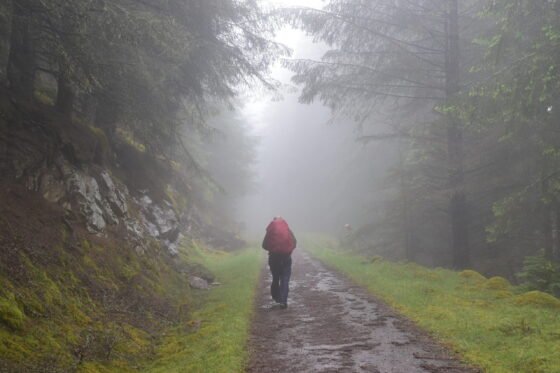
Just another soggy day on the Great Glen Way
Useful info for those walking the Great Glen Way
Transport to and from the path
It’s not too difficult getting to Fort William, and it’s even easier to get back from Inverness which is well connected by coach, train and plane. The only problem is that, for most of us, it does take an awfully long time to get there. Even travelling the relatively short distance from Glasgow to Fort William takes almost four hours – though by way of compensation this also happens to be one of the most scenic train journeys in the UK and includes a spectacular crossing of the Glenfinnan Viaduct, which features in the Harry Potter films. But living at the other end of the island, near the south coast, it took us about 15 hours to reach the starting point of the hike.
But at least you can get to the actual start and end points of the hike by public transport and you don’t, as you do in some trails, need a taxi.
Transport along the Great Glen Way
When updating a guide book I find myself continually travelling back and forth along the path to research all the alternative routes (which, on the Great Glen Way, as you’ll find out, are many). On other trails I have walked, this whole process is often very time-consuming and, given that taxis are sometimes the only option, rather expensive.
But on the Great Glen Way things were much simpler. The electric bus company, Ember, has 13 buses a day travelling each way up and down the Way, stopping at pretty much every settlement on (and off) the trail. What’s more, booking the ticket online beforehand (make sure you do this at least ten minutes before the bus is due or it may not stop at all) was easy.
But it is the bus journey itself that is the real treat. The buses were punctual (and I received regular updates on my phone if they were going to be late), the drivers friendly and the seats comfy. Once we’d plugged in my phones to recharge, we could just sit back and gaze at the gorgeous Scottish scenery whizzing past us. And all this for just £2 a ride!
Yes, you read that correctly: each journey we took cost us just £2!
I am even 90% sure that the bus driver greeted me with a cheery ‘Hello Henry!’ on my first trip – which I’m pretty sure is the first time I’ve been greeted by name on any public transport!
Apparently, the fact each journey was only £2 is actually a government initiative and both Stagecoach and Citylink – the other two main bus companies in Scotland – also offer £2 tickets. Passengers over 60 get it even better – for them the journeys are free! The Scottish Government reimburses participating bus operators for the difference so that routes remain profitable.
Given the shortage of accommodation along the path, you may find you need to travel several miles at the end of each day’s walk to your hostel or B&B – and the same journey in reverse the next morning. But thanks to the bus service along the Great Glen, this is not the expensive, logistical nightmare you may have feared.
Walking the Great Glen Way with a dog
As you should by now have realised, I have no first-hand experience of what it is like to walk the trail with a dog. But I met several people who were, and they all said much the same thing: that the big problem was not the walk itself, but all the other stuff. In other words, when they were on the trail it was easy, but finding somewhere to stay that allowed a dog was hard, and occasionally – just occasionally – they weren’t allowed to bring their dog into the café and had to sit outside, which was fine if it wasn’t raining, but, this being Scotland, it very often was.
But those problems aside, they and their dog found the trail pretty straightforward. Indeed, given how seldom you encounter busy roads or have to cross cow fields (indeed, I can’t remember encountering any cows on this trail), this may well be one of the better trails for dog-owners. Besides, finding somewhere to stay can be tricky for every walker on the Great Glen Way, not just dog owners; indeed, this is one of the few paths where some of the hostels actually allow dogs in some of their private rooms!
One word of warning, however: if your dog likes to wander and is reluctant to come to heel, consider leaving him on the lead for the majority of the trail. You will spend much of your time on the Great Glen Way walking on large tracks through pine forests, and there are thus infinite opportunities for your dog to go wandering off. Be careful.
Other than that, just take care and follow the usual rules about walking a dog along the trail.
So where might I get lost? The path is very well waymarked with blue posts so you shouldn’t get lost for too long. There are a couple of places to be wary, however. Firstly, a lot of the walk is conducted in managed pine forests, as we mention above, and diversions are usually put in place when tree-felling is actually taking place. These diversions are not always brilliantly signposted – the signs themselves are sometimes little more than laminated pieces of A4 with an arrow on them. So take care on these diversions and keep your wits about you.
There is also the new high-level trail to the summit of Carn na Leitire. This is now an official alternative route and it does take you away from the logging track for a couple of miles. The trouble is, someone’s been over-zealous with the signposts and many path junctions have signs that say ‘Great Glen Way’ but unfortunately are not the correct path to take. If you obey these signpost you’ll end up back on the logging track without reaching the top of Carn na Leitire. Thankfully there is a simple solution: ignore these signposts for the time being and instead just follow the blue posts, which will take you safely up to the summit and back to a reunion with the ‘regular’ Great Glen way.
Camping & accommodation along the Great Glen Way
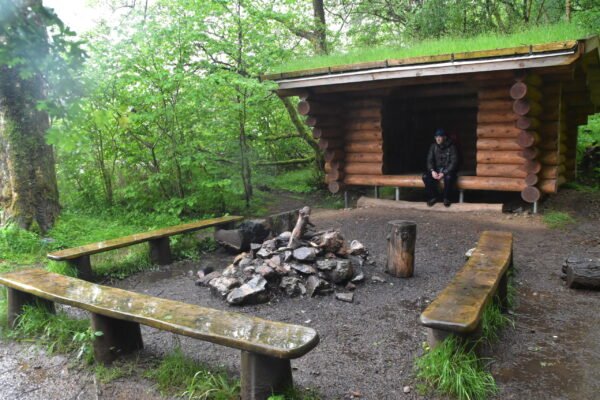
The Great Glen Way is great for campers. This is not unexpected; after all, Scotland is the only country in Britain where wild camping is allowed and campsites abound.
But on the Great Glen Way they go that little bit further. For in addition to the regular campsites – of which there are quite a few along the trail – and the opportunities for wild camping (which, in theory at least, means you can camp just about anywhere), they also have something that we have called ‘official wild campsites’.
This term may seems oxymoronic. After all, the main point of wild camping is that nobody is dictating to you where you should camp. But while some wild campers may bridle at staying where the authorities clearly want you to stay, it’s hard not to be charmed by the efforts that they’ve gone into making these official wild campsites comfortable. A couple of the larger ones have spacious wooden shelters, fire-pits and even compost toilets. (These compost toilets are usually locked, by the way, but you can get a key from offices at either end of the trail – see the book for details.)
And these campsites are necessary too, because it can be surprisingly difficult to find a flat sward of grass where you can pitch a tent along the trail. There’s seldom enough room to pitch a tent when you are walking along the towpaths on the first half of the trail, while the pine forests in which you spend much of the second half of the walk offer little flat ground or are on a steep slope. Indeed, often wild campers end up just pitching their tent on the actual path as there’s nowhere else to go, which isn’t ideal.
The only disadvantage that these official wild campsites have compared to a site that you have found yourself is that, of course, it will be more likely that other wild campers may join you. But for most people this is a small price to pay for the extra shelter and the compost toilet that these wild campsites provide. They also tend to be in fairly remote locations, too, so anybody who joins you is likely to be a fellow hiker or canoeist. And best of all, like any good wild campsite, they are all free of charge.
The hostel and bunkhouse situation is equally excellent. This is the first trail I’ve been on where not only can you stay at a hostel for every night of your walk but a few places (Fort William, Drumnadrochit and Inverness) even allow you a choice of hostel (indeed, Drumnadrochit and Inverness have three!) Nor is it just the number of hostels that’s impressive – the hostels themselves are great too. Large, friendly, facility-filled and full of like-minded hikers, these places provided us with some of the best memories of the entire walk, as I am sure they do for many trekkers. Indeed, one of them even hosts its own ceilidh every night! I’d all but sworn off hostels having had too many bad experiences with heavy snorers and inconsiderate school groups. My experience on the Great Glen Way has caused me to reconsider that decision.
The B&B/guesthouse and hotel situation on the Great Glen Way is, however, not great. The bigger places – Fort William, Fort Augustus and Inverness – do have plenty of options so finding something there shouldn’t be too tricky. But the smaller places in between – Invergarry, Invermoriston, Drumnadrochit – often have only a few places to stay, and that number is dwindling year after year too. One of the problems, apparently, is that since Brexit the hotels and larger B&Bs have really struggled to find staff of a suitable quality. Indeed, one hotel we visited is currently shutting at weekends over the summer – when they should be at their busiest, of course – because they simply don’t have the staff to cope!
Facilities along the Great Glen Way
Food and drink The main towns on the Great Glen Way – Forts William and Augustus and Inverness – are major tourist hubs so you’ll have no problem finding somewhere to eat there. And even Drumnadrochit has a lot of choice of eateries thanks to its location at the heart of the Loch Ness Monster tourist industry. Which just leaves those little in-between places such as Laggan, Invergarry and Invermoriston, where there may be just one place to eat. But there is, at least, one place at every stop.
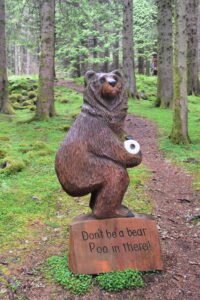
Toilets and drinking water Most places have some sort of toilet facility and though we encountered a few that seemed to ask for payment, the barriers were seldom in place. A drinking water tap was often located nearby too. Away from the settlements, of course, you’ll just have to go where the bears go. Do carry enough water with you when you’re walking as there’s seldom anywhere to get safe drinking water when you’re up in the hills.
Shops, banks and ATMs Bring some cash with you as you won’t find many cash points outside the main towns. But once you have the cash you’ll find places to spend it, with even the smallest places often having somewhere where you can stock up on provisions.
Trekking companies and baggage carriers As one of the most popular trails in Scotland, it’s no surprise to find the Great Glen Way features on the roster of just about every walking company in the UK.
Dangers and annoyances
 The first annoyance we have to mention are, of course, the midges. If you can, try not to walk in a season where the midges are active. Time you hike right and you may wonder what a midge is. Time it wrong, however, and you may not be able to think about anything else. Those hats with the netting veil around them provide good protection, and many people still swear by the protective powers of Avon’s Skin So Soft, which provides an oily barrier against the midge’s worst intentions. The problem is, according to users, that the barrier only lasts for an hour or two before reapplication is required. For this reason, many walkers now recommend Smidge, the effectiveness of which is said to last for about 8 hours.
On the subject of biting insects, Scotland is also the spiritual home of ticks, which are far less ubiquitous than midges, but their bite is far more serious. Indeed, if the tick is carrying Lyme’s disease then it may even be fatal. Wearing long trousers, particularly in long grass, will help prevent them from be able to bite you.
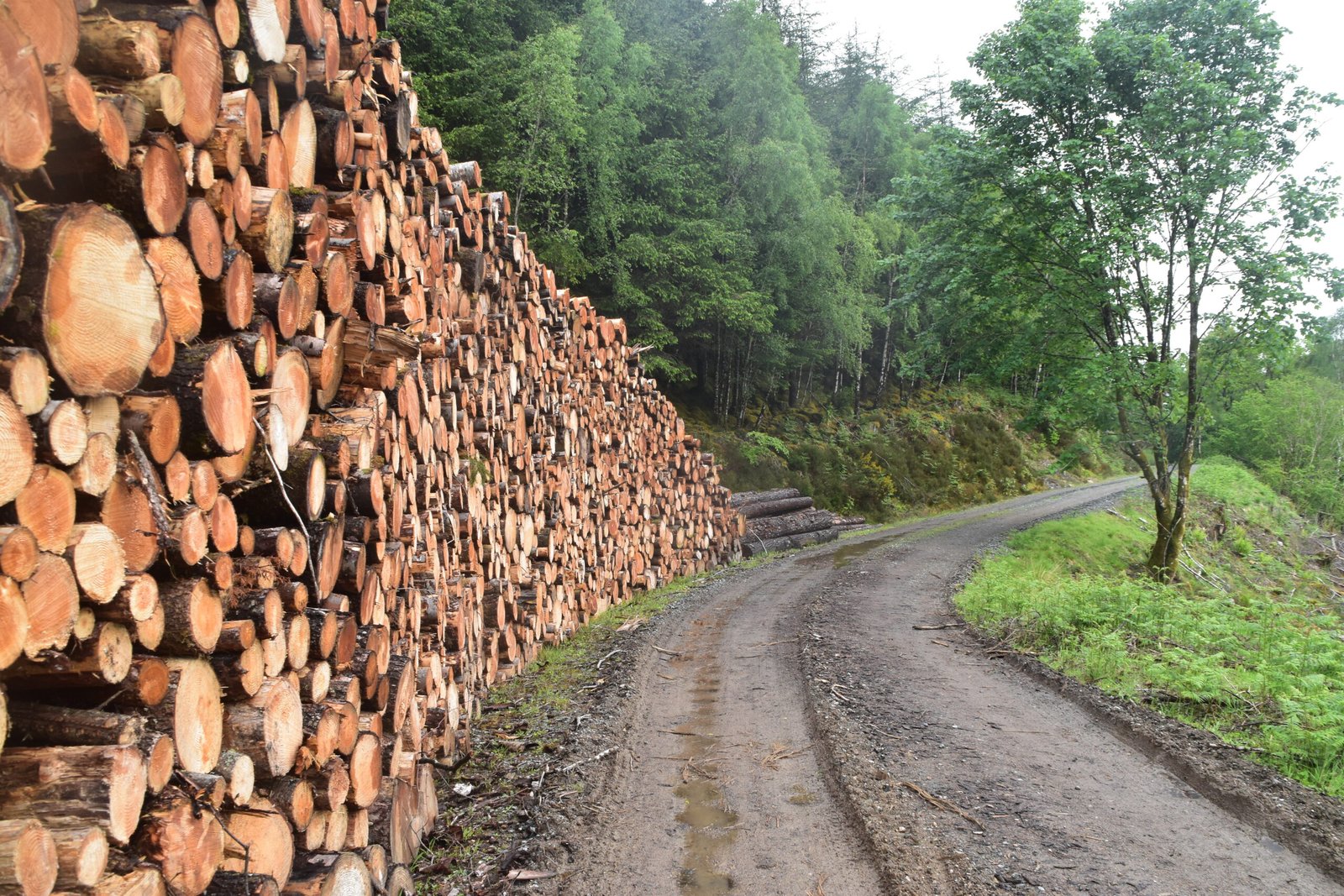
As for other dangers, well the logging industry certainly has plenty of machines that can sever and maim, so obey all the signs that they put out and diversions they create if they are working alongside the trail. And don’t try clambering on the log stacks, of course, no matter how tempting.
Tips and hints
- When it comes to the alternative routes, my advice is as follows:i) If you’re coming from Fort William, don’t take the alternative path from Laggan Locks to Aberchalder via Invergarry. There’s not much in Invergarry these days anyway, and the surrounding forest has suffered from the attentions of the logging firms more than anywhere else. Stick to the eastern side of the loch and along the disused railway as it’s much more interesting and picturesque.
ii) From Fort Augustus, the high level route to Invermoriston is vastly superior to the low-level alternative.
iii) Similarly it’s best to stick to the heights from Invermoriston to Drumnadrochit – indeed, many reckon this to be the best stretch of them all.
iv) Though the last day is long, if you can squeeze in the brief alternative trail to the summit of Carn na Leitire then we think it’s worth it. - If you have a spare day, spend it in Inverness – there’s a lot going on and it’s a lovely place to just hang out.
- Don’t just work out where you’re going to stay each night – work out where you’re going to eat too as there aren’t (m)any café’s along some stretches of the trail.
- It does involve a bit of extra pfaffing, but there’s a sauna at Aberchalder that’s a bit of treat! Book in advance on the Great Glen Sauna website.
- The Abriachan Eco Café and Campsite is the most heavily advertised café I have ever come across on any national trail. There’s a homemade advert for it every few metres along the path for about a mile. And Jim, who wrote the guide I was updating (and whose opinion I value) waxed lyrical about it in the book. But just recently there have been several negative comments about it online, and I wasn’t completely convinced about it when I visited either. It’s certainly quirky, which is a quality I find charming, but it was also (I think) overpriced and the owners weren’t entirely friendly (indeed, some reviews suggest they can get positively hostile). I wouldn’t entirely rule out a visit as it’s certainly unique, and some people still love it. But if you are looking to have lunch there, maybe have an alternative plan, just in case.
The Great Glen Way: Further info
- Great Glen Way – The official one
- Click here for the relevant page on the Scotland’s great trails site
- Wikipedia have a page on the Great Glen Way too
The Great Glen Way Guide!
‘…the Trailblazer series stands head, shoulders, waist and ankles above the rest. They are particularly strong on mapping…’ The Sunday Times
‘A definitive guide to the trail and would recommend it, both for planning your walk but also during it.’ Backpack magazine
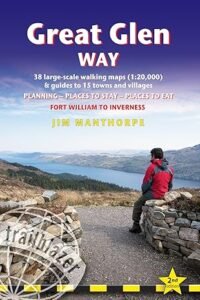
All-in-one, practical guide to walking the Great Glen Way long-distance footpath.
This 2nd edition has been re-walked and fully updated.
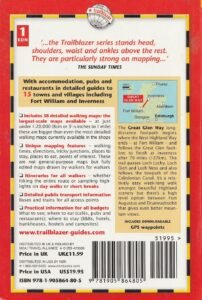
* Includes 38 detailed walking maps in two-colour style: the largest-scale maps available – at just under 1:20,000 (8cm or 31/8 inches to 1 mile) these are bigger than even the most detailed walking maps currently available in the shops.
* Unique mapping features – walking times, directions, tricky junctions, places to stay, places to eat, points of interest. These are not general-purpose maps but fully edited maps drawn by walkers for walkers.
*With accommodation, pubs and restaurants in detailed guides to 15 towns and villages including Fort William and Inverness.
* Itineraries for all walkers – whether hiking the entire route or sampling highlights on day walks or short breaks.
* Detailed public transport information – Buses and trains for all access points.
* Practical information for all budgets.
* What to see; where to eat with reviews (cafes, teashops, pubs, restaurants, takeaways); and where to stay with reviews (hostels, campsites, bunkhouses, B&Bs, hotels).
* Downloadable GPS waypoints also included.
* Written by Scottish hillwalker Jim Manthorpe.
Buy the book:
To buy your copy from Amazon, please click on the book below: